Friday, April 5, 2019

Digital vs. Analog | Writing Across Curriculums

Digital vs. Analog technology W.A.C

As technology continues to further evolve, we become able to do things that we weren’t able to before and enhance the experience of things like entertainment. Unlike analog graphing, digital graph will not only get better in the future, it is already better and easier to use than analog is. Digital technology is already easier to use than that of analog, not only is it less expensive, it’s also more widely available, and anyone can do it. Editing can fix all of the issues that people may have with digital technology and make the music sound better than it did before. Lastly, as time moves on the technology will continue to improve and get better, surpassing analog technology by even more than it does now. By far, digital technology is much easier to come across today than analog technology, not only that digital is much easier to use than analog is.

While analog technology has been around for ages, since man has started to make music, in the short time that it has existed digital technology has already become much more available and easy to use than analog technology is. Rather than having a confusing instruction manual like analog technology does, digital technology has easy to navigate, use, and understand help pages that anyone can use if their confused. So learning how to use digital technology won't be an issue if the company uses digital. Not only that, but the ability to find a piece of analog technology today is much harder than the ability to find a piece of digital technology, and much less expensive as well so almost anyone can find and buy all the necessary equipment, so money wont be as much of an issue as it was before. Through the power of editing we can put in all of the subtleties that may have been missed in the recording and sampling of music being played, holding it to a higher sound quality and precision that analog technology has.

With advanced editing tools that are widely available and easy to use, digital sound can have all of the subtle parts of the music that may have been missed during sampling, meaning that digital technology can have the same level of sound quality as digital has. Using separate recordings, and control over the level of volume a noise has, editors can put in all of the subtle pieces of music that may be present throughout the piece, is it’s skipped over during sampling, meaning that digital can have the same level of music integrity that analog has. Not only that but editing is a much faster and less scary process than before, because there is an undo button if something is accidentally deleted, it doesn’t have to be recorded again, which would cost the company time and money. Meaning that our company would be saving money if we switched to digital. Digital technology has a lot of great points about it, does analog technology have any kind of advantage over digital technology in this debate?

While digital has a large amount of upper hands on analog, it gets beat out in one aspect of sound, and that is all of the smaller harder to notice sounds in music, which are subtle noises that make the song all that much more enjoyable than if they weren’t there. When people use digital technology, it doesn’t convert the entire song onto the computer, only parts at a sampling rate, which can leave out parts of the song that would make it much more enjoyable than it was before. While songs made using analog technology always picks up the entire song, so when digital technology is used all of the subtle yet really enjoyable parts of the song are left out, which can lose a lot of money for the company producing the technology and music for people to enjoy. Even though lots of enjoyable parts of the song are left in the initial recording, they can still be recorded and added in later via editing, which means people can enjoy all of the parts of the song as if they were listening to it on a vinyl record.

As time passes on digital technology will continue to keep improving and it will keep getting better and better, meaning that not only will it become even more accessible to people, it will also have a lot more uses than it would today. Every day, people around the world are working to make more and better technology, meaning that technology has almost a 100% chance of being improved in one way shape or form, this includes music technology meaning that digital technology will continue to surpass analog technology every day. The technology used for making music can be improved in lots of different ways, like the sampling rate may continue to increase meaning that people will eventually be able to hear all of the subtleties in the music from the initial recording, which reduces the amount of work that needs to be done. There are lots of ways that digital technology is superior to analog technology, and there are lots of areas that digital technology will be better than analog technology in the future.

Not only is digital technology better than analog technology right now, it will also continue to be better than analog technology in the future. Meaning that it will continue to improve and get better for anyone to use. Digital technology is much easier to use than analog technology with all of the guides and help pages, it’s also much more available these days as compared to analog technology. Almost all of the problems that digital technology and recording has can be fixed by recording more audio and editing the audio that was already there before. As time moves on digital technology will continue to improve and get even better than before, continuing to surpass analog technology. As you can see digital technology is far superior than analog technology, and while both have their good sides, digital beats out analog in almost every way shape or form, meaning that digital is the overall better option than analog.

Sunday, March 31, 2019

Electromagnetic spectrum

EM spectrumvised By: Philip Ronan, Gringer


Summary: The electromagnetic spectrum is where all light in the universe falls into, things like radio waves, and gamma rays are some examples of what falls on the spectrum. Even though we can't see most of the light on the electromagnetic spectrum, we have found ways to measure it, both analog and digital, so that we can visualize it to better study all of the different types of light. Only one part of the spectrum can be seen by the human eye, this is called the visible spectrum, which includes all of the colors of the rainbow, and is its own spectrum.

SP4: Analyzing and interpreting data
We took a look at a single graph that was incredibly smooth, and had to plot out ten points that all fell on whole numbers, we then repeated the process but we had to plot out 20 points and they could be whole or fall on half numbers. We observed that as the more points were added to the graph, it not only got smoother, but it also got more accurate to the original graph that we were basing it off of, which shows how accurate results can be given by human hand. 

XCC: Patterns
On the electromagnetic spectrum you can see that the shorter the wavelengths get not only do the waves get warmer and warmer, the frequency also increases. The smaller the frequency is the warmer the color it is represented by is, with one noticeable change of color right where the visible spectrum is, this also correlates to the warmer the wave is at its max power, than the cooler the color its represented by on the spectrum. Meaning that the smallest thing on the spectrum, gamma rays, would have a very light purple representing its frequency and a temperature of about 10,000,000 K.

Sunday, March 24, 2019

Musical Instrument Project

 
Image Link


Summary: Various different types of waves can affect the world in different ways. Like how sound waves can make things audible to the human ear, or how seismic waves can make the ground shake greatly. Even though you can't see them, this applies to electromagnetic waves as well, like how a UV ray can cause a person to get a sunburn, or how X-rays allow us to see inside of our own bodies. Almost, if not all waves can effect the world or the things on it in various ways.


Backward-Looking
In school I personally learned about sounds and waves beforehand, but did not know as much on the topic as I would have liked, meaning that I learned a lot about the topic by working on the project. Specifically things like: the different ways to measure the wavelength and amplitude of different kinds of waves. I gained a lot of knowledge by working on the project.

Inward-Looking
The thing I like the most about this project is the fact that it is flowing with creativity, showing how my team and I can take a task as simple as creating an instrument and making something incredible out of it. The one thing I dislike about the project is that some of the decorations on the instrument itself are lack luster, specifically the 'ears' on the side of the instrument look really bad and poorly done.

Outward-Looking
If I were to give this project a grade I would give it a A, because the project can play any note at a variety of pitches, and not to mention it doesn't take any real skill to play, along with its uniqueness. We made and incredibly interesting design for our instrument, and decided to go with a design that was simple but also really cool. While some parts of the instrument don't look that good, it mostly does as all of the other pieces of the instrument are cool references.

Forward-Looking
The one goal I would like to set for next time is:

When designing a unique solution to a problem, and my team and I hit a roadblock, than rather than doing a small and boring fix, we make it so that the solution fits into the project really well. I say that this is my goal because in our project we came to the roadblock of the sound not being very audible. So we came up with a quick fix to our problem, which was cutting holes in the side. I wish we came up with a greater solution next time.

Friday, March 15, 2019

Sound

Audio Database By: Aarkentechnologies 


Summary: Sound is a mechanical wave that allows us to hear various noises. Sound is a longitudinal wave meaning instead of going up and down, it compresses, and decompresses. Sound is also a type of energy, meaning that it can be used to manipulate matter, different sounds exist because of the fact that they manipulate the air around it. The frequency of the wave is directly related to the pitch of the sound, meaning that the louder the sound, the larger the frequency.

SP5: Using mathematics and computational thinking
We had to use various different types of math to find out about different properties of a wave. We had to do various measurements on things like the distances between two troughs, and the distance from a trough to the top of the wave. We used these measurements to figure out things about the wave, like its frequency, its wavelength, and the amplitude of the waves we measured.

Energy and Matter
Sound relates to energy and matter, because sound itself is a form of energy, you can use sound and the vibrations that it creates to manipulate matter. Matter is also related to sound because it is a mechanical wave, meaning that it cannot exist without matter, because it has to travel through matter to exist, specifically travelling through matter in the form of vibrations.

Sunday, March 10, 2019

Waves

2 fixas By: Felipe Tomazoni


Summary: A wave is how various things in the universe move, it's the type of form that something takes. There are two basic types of wave: Electromagnetic, and Mechanical, with the main difference between them being how Mechanical waves need a medium, or matter to move, however an Electromagnetic wave can move through nothingness, also known as vacuum. Then there are two more sub types of waves, Transverse, and Longitudinal waves, which have to do with how the wave moves. A transversal wave goes up and down in humps and troughs, while a longitudinal wave compresses at different parts.

SP3: Planning and carrying out investigations
In order to figure out how sound moves and reacts to different states of matter, we did a lab that involved hitting tuning forks against a table and touching it to different things to see how the items would react. During the investigation, we found that the vibrating tuning fork would make water jump, and when a ball on a string would touch it, the ball would bounce away, no matter how softly we touched it with the vibrating fork.

XCC: Energy and Matter
Lots of different forms of energy travel as waves, such as sound energy, which travels as a longitudinal wave. Matter is needed for the existence of mechanical waves, which need a matter as a medium that they can pass through. Sound is a prime example of this as it can only travel through matter and cannot exist in a vacuum, and it is a type of energy, meaning that energy and matter are incredibly important to the existence of waves. 

Friday, March 1, 2019

What effect can very loud music have on your hearing?

Anatomy of the Human Ear By: Dan Pickard

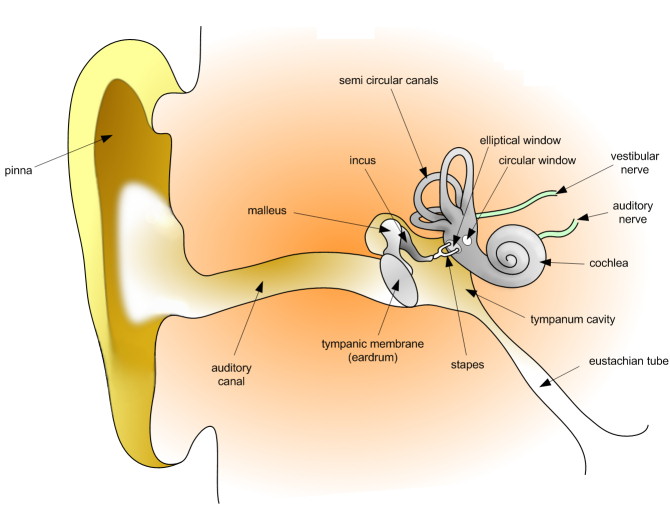
When loud noises enter your ear they are quite violent vibrations entering your ear, which can cause a variety of problems. When entering your eardrum, the violent vibrations of sound can cause your eardrum to shake so violently that it can rip or break, which can be as bad to cause a person to go deaf. If the violent noise makes it to the cochlea, it can cause the hair cells on the inside to shake violently, which can cause the tips to break off, which means they will constantly be emitting electric pulses to your brain confusing it on whether you're supposed to be hearing something or not, making a ringing noise in your ear, which can last from 1 day to the rest of your life. While some loud noises are okay, others will cause damage to your ear that may be permanent and life hindering.

Friday, February 15, 2019

Roller Coaster Project


Summary: In physics there are various parts that allow the universe to function the way it is supposed to. Energy, which is how everything in the universe is powered, allowing for things like movement. There is force, which uses energy to push or pull an object into various different positions. Then there is motion, which is when both energy and force are put together to allow an object to change positions.

Backward-Looking
In or out of school I have never done a kind of work that needs as much knowledge as this one, where the only limitations are the requisites and your budget, and it has to be fully functional .  With little limitations it allows the creativity to run wild, creating something that you can feel attached to unlike most other projects where you just follow the guidelines and your done, with the only drawback being, the crazier the project, the harder the calculations.

Inward-Looking
The thing I like the most about this project is the fact that it is flowing with creativity, showing how my mind works and calculates, and not how it reacts to various tasks. The one thing I dislike about the project is that some of the theme behind our roller coaster is kind of bad, most of our ideas were thought up before we chose our theme, so we built our the around the roller coaster and not the other way around.

Outward-Looking
If I were to give this project a grade I would give it a A-, because there was a lack of thought involved with some parts of the project. Rather than making an interesting roller coaster we decided that we would go with a much, much simpler design than what was necessary . We then came up with various reasons that the organism would evolve to be this way.

Forward-Looking
The one goal I would like to set for next time is:

rather than impeding the final outcome of the project by choosing what a simpler design, then an interesting one. I will look at my capabilities  first, then make decisions based off of that, rather than basic abilities. Allowing me to be more efficient and have a better work ethic to make a better project, and enjoying it along the way.