Sunday, October 28, 2018

The Evidence of Evolution

Haeckel drawings By: Phlebas

There are various form of evidence that can prove how evolution exists, and what changes evolution has caused various creatures to go through. One of the many forms of proof is the fossil record, in which we look for fossils of the same species, and see how they changed by looking through how old each fossil is and the differences between each fossil. Another one of the many forms of proof is embryology, which Charles Darwin, the man who made the theory of natural selection, is the strongest evidence for evolution. When we look at embryos we can see the similarities between each species to see how closely related different organisms are to each other. Such as how lots of embryos look similar when they are first conceived.

SP2: Developing and using models
When we were studying the fossil record, and how it can be used as evidence for evolution, we made a poster that had various pictures of one species of animal, showing how it evolved over time. As time went on during the model, the creature started getting more and more complex with each change in the fossil. We also got a paper with various embryos of different species on it, we colored in each embryo a single color, until an embryo would physically differentiate from the others, showing us how closely related our species are to other species.

XCC: Patterns
Looking at the changes in various embryos and fossils, it is possible to see a pattern form in different species. When to species of organisms, are closely related via a common ancestor, you can see that in their fossils, and embryos. When you look at the bone structure, you can see that they have a similar number of bones, that work in similar ways, like how a monkey and a humans bone structures are similar. When looking at the embryos of two closely related animals, the closer they are to being related, the longer the embryos will stay the same visually.

Sunday, October 21, 2018

Charles Darwin

Charles Darwin 1880 By: Elliot & Fry


Charles Darwin is a scientist that lived in the 19th century and made major break troughs when is came to evolution. Charles Darwin was studying Finches on the Galápagos islands, when one day he noticed that on each different islands, the finches had different characteristics. He also noticed that each type of finch was better suited for its environment, than the other types of finches. He then made the hypothesis that that animals with more survivable traits would reproduce, while animals that don't have those traits would die without reproducing. This process would later be known as natural selection.


SP4: Analyzing and interpreting data
While we were studying the effect of the amount of rainfall that occurred each year would cause to the deepness of a finches beak, we had studied graphs, and determined how the beaks of the finches changed, if it was significant or not, and what the cause was. We then used that data to make predictions on how different amounts of rainfall would affect the finch population.

XCC: Cause and effect
When the amount of rainfall changes, the size of finches beaks also change. When we look at the relationship between the amount of rain, and the size of finches beaks, we can learn how the finches will be effected due to major changes in the climate. We can also observe the mean average deviation for the rainfall before it starts effecting the finches. We can use this information to study not only finches, but various other organisms in a lab environment.

Sunday, October 14, 2018

Evolution

Ape to Man By: Appalanaidu Pappala


Evolution is a change in the gene pool over the course of many generations. Evolution has 4 main forces that guide it so that animals can not only adapt to their environment, but also avoid death long enough to reproduce to their full potential. These 4 forces guiding evolution are: Mutations, Natural Selections, Genetic Drift, and Genetic Flow. Mutations are changes in the genes that are mostly random, and as such can have positive and negative effects of the mutated organism, though most mutations are neutral. Natural Selection is the process where animals that have more survivable traits can reproduce to their full potential, while animals that don't have the same gene die before they can reproduce. Genetic drift is the gradual loss of genes, most occurring in small populations of organisms. Genetic Flow is the transfer of genes from one population to another population.

SP4: Analyzing and interpreting data
In class, we did a lab in, which we recorded the data of M&Ms on a table as if they were a population going through evolution generations at a time. We looked at the table that we made and figured out if mutations had become a prevalent feature in the population. We also saw what affect having a smaller population of only select individuals would have to the gene pool.

XCC: Systems and System Models
In evolution, there are 4 different systems that dictate how an animal can change, like if an animal has natural camouflage to hide from predators, or the intelligence to make cover for them to hide in. With mutations that is mostly random, it doesn't tie into the other three functions as well either. But with the other three functions they tie into each other nicely, an animal moves from one population to another. That animal finds them self in a smaller population than before, it reproduces and over generations. That animals gene becomes more prominent, because not only is it a dominant trait, it is also more survivable so, animals that posses that trait are able to reproduce to their full potential. What just happened was not only genetic flow, but also genetic drift, and natural selection.

Friday, October 5, 2018

Are we in a 6th mass extinction?

Are we in a 6th mass extinction?

By: Michael Wilkinson

Throughout the geologic history of the Earth, there have been a multitude of different types of events. The most famous type of all is the mass extinction event. Due to various causes, most especially humanities impact on the Earth, we are going through an event, a mass extinction event. Though it is a bit different from the other events like this one. How is this event different from other extinction events that have happened in the past? Why is it different from other mass extinction events that have happened already?

The mass extinction we are in is different from others, in lots of different ways. From the type of extinction, to how long the extinction will take. The extinction is ongoing, so that rather than over a short period of time 70% of all life dies, that 70% of life will die out overtime. In the article, Mathematics Predicts a 6th mass extinction, Daniel Hoffman who was being interview said this: “This is not saying that disaster occurs the next day,” Rothman says. “It’s saying that, if left unchecked, the carbon cycle would move into a realm which would be no longer stable” If we were to reach that point, that is when we would be at the height of the mass extinction. The carbon cycle won’t reach its peak for a while though, as humanity will have to add a ton of carbon to the ocean, 300 gigatons, to be exact. Researcher Daniel Hoffman said in Mathematics Predicts a 6th mass extinction, that we wouldn’t reach that point until 2100. If the extinction event is so far away, then how come we are in a mass extinction event? Shouldn’t the mass extinction event start during 2100?

While we won’t hit the peak of the mass extinction event until 2100, the mass extinction event is still going on, rather than everyone dying almost instantly, it takes a long time for us all to die, so the extinction event is ongoing. In a study, the authors that had performed the study had said that the extinction event was ongoing. So, it will take a long time for the big results to show, but you can already see evidence in one place, when it comes to the event happening, in the world of animals. While in humans there hasn’t been any major population decreases, you can just look to the world of animals for evidence that we are in an extinction event. In the article: 6th mass extinction ‘the era of biological annihilation’ the author writes “Meanwhile, as this research shows, entire populations of other plants and animals are crashing, even if they're not yet on the brink of extinction. Some of these are well-known.” Couldn’t this all just be a coincidence, this could just be the effect that global warming has on the environment, and there is no extinction event that is going to happen?

Some people say that we aren’t in a sixth mass extinction event. That this isn’t like what happened millions of years ago, like in the Permian - Triassic Extinction event. The climate, they say- isn’t like the ones you would have seen earlier in the Earth’s history, the horrible skies the harsh air, that would have lasted, thousands, to maybe even millions of years. In the article, Paleo Expert: Earth is not in the Midst of a Sixth Mass Extinction, the author wrights: “By comparison, the hellscape of End-Permian mass extinction claimed upwards of 90 percent of all species on earth.” Saying that this is not like what other mass extinction events are like, that this is nothing like a mass extinction event. The thing about this mass extinction, is that it is different from other mass extinctions, it’s ongoing. We’re simply in the beginning of a new mass extinction event unlike ones that have happened before.

The effects of the mass extinction event are already showing. We are seeing the effects of pollution and other things that have taken a toll on the wildlife. Animals have been dying left and right these days, and it’s no better in places like the north pole, where the ice is melting and the climate is warming up, making it much harder for the wildlife up there to survive.

In the article, Sixth mass extinction: The era of 'biological annihilation' it is written that: “Their key findings: Nearly one-third of the 27,600 land-based mammal, bird, amphibian and reptile species studied are shrinking in terms of their numbers and territorial range. The researchers called that an "extremely high degree of population decay."” Meaning that almost ⅓ of the species on Earth are in decline right now. There is a lot to this mass extinction, like how it’s so special, why is all of this happening, how is it different, and where is the evidence of all of this happening?

Despite it being different from others, we are currently is a 6th mass extinction one that will be on the level of the Cretaceous–Paleogene extinction event, that killed the dinosaurs. The extinction is ongoing, and is different from other events, it will reach its peak in 2100, and it’s taking time for major results to show. But there is evidence to support this, the extinction rate of animals is climbing and it's going to be incredibly high by the time the extinction reaches its climax. The cause of the extinction is well known though, it’s that human are ruining the environment, and polluting the skies and water, which is devastating for the wildlife, and soon it will be dangerous for us.

Sunday, September 30, 2018

Mesozoic Era

Geologic Time Scale By: Hayden Hogen-Esch

The Mesozoic era is an era in the geologic timescale, in which the dinosaurs were the main species of animal that ruled the land. This time is also when the first mammals appeared on Earth. During the Mesozoic, Pangaea was still formed, but it later split apart, into two different super continents, called: Gondwana and Laurasia. The climate in the Mesozoic era was much dryer compared the Paleozoic era, having much less marshland, and much more deserts. 

Backward-Looking
When it comes to making interactive posters I need to improve a lot more, because when it came to making a poster, all I really made was flaps that you could put up to see information. What I really want to do is find the perfect balance between putting in information, and user interactivity. So that when people look at the poster, they are not only interested, by the interactive parts, they also learn about the subject at hand.


Inward-Looking
One thing I found frustrating about the project was the fact that not all of the teammates did all of their work. Before one of the members could put any information on the board they left on a vacation, leaving one member to do a lot of the work. One member also couldn't finish their work in time so, the same member that picked up for the last persons slack, also finished their part of the project, which was frustrating for me to watch, and not be able to help as much.

Outward-Looking
If I were to give my part of the project a grade, I would give it a B, because I feel like it got out all of the information that it needed to get out, and also had some interactivity. But I feel like the project doesn't go beyond, it only does what it needs to do, and I would have put more information and I would make the user interact with the project more, and also in a better way.

Forward-Looking
One thing I would like to improve is my creativity, when making the project, I didn't have any real ideas on what to put on the poster, I knew I had to have some interactivity, so I put information on flaps and left it at that. I would like to make it more interesting for people to not only look at, but also to play with. I need to find more ways to ignite my imagination. 


Sunday, September 23, 2018

Geologic Time Scale

Geologic Time Clock By: Woudlooper
The geologic time scale is a scale that represents the entire history of the earth, The geologic time scale is separated into different eons, which have eras in them, which have periods in them. Each period is separated by a geological event, such as a minor extinction event. Each era is separated based on a major geological change, such as a major extinction event. The geologic time scale is separated into four main eras, the Precambrian, the Paleozoic, the Mesozoic, and the Cenozoic.

SP1: Asking questions and defining problems
The questions I asked in class were quite varied, I asked questions such as what killed the dinosaurs, and how did we know that? I defined problems with many different hypotheses proposed by different scientists. I used the problems that I found in each hypothesis to determine, which theory is the most accurate as to what actually happened. This allowed my to reach the most accurate data, I could think of.

XCC: Cause and Effect 
During the different eras there were many things that led to other things, like the meteor that caused a major extinction event at the end of the Mesozoic era, caused lots of dust particles, and other things to fly into the air, blocking out the sun. This caused the temperature on Earth to drop significantly, and cold blooded animals like the dinosaurs died out. That is when mammals took over, being able to scavenge for food, and their warm blood, and fur coats helped them out to. So, because the meteor hit the Earth, mammals were able to become a much more prominent type of animal. 
  

Sunday, September 16, 2018

Rock Cycle

Rock Cycle By: Woudloper/Woodwalker
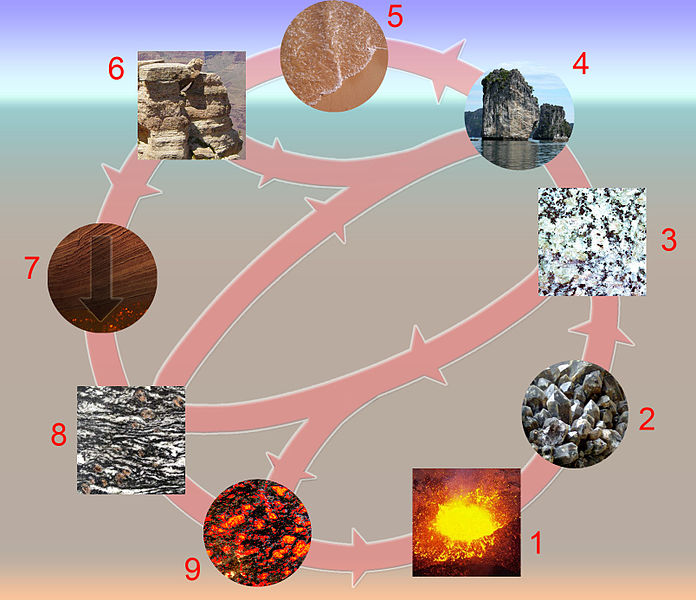
The rock cycle is the process in, which rocks change into different forms of rock, through processes like weathering and erosion. There are three types of rock, Sedimentary, Metamorphic, and Igneous. An important part of the rock cycle is any form of rock can change into any other form of rock. When a rock goes through weathering and erosion, then compression and compacting it turns into Sedimentary rock. When a rock goes through a lot of heat and pressure it turn into a Metamorphic rock. When a rock melts, and then it cools, it turns into an, Igneous rock.

SP2: Developing and using models
The model we used in class was a version of the rock cycle, where a student represents a rock in the rock cycle and we roll a dice to see where we are going next. Another model we used was gizmo that helped use describe the processes a rock goes through during the rock cycle, it also helped us see that there are various smaller cycles in the rock cycle.

XCC: Patterns
A pattern we observed in class, was the pattern that we use to find out the relative age in rocks, as in the age of a rock compared to the ones around it. The pattern that we saw was that, when rocks appear on multiple layers, those layers must be next to each other. If a rock is on one layer, but not the next then that rocks lifespan is over (We use fossils found in the rocks lifespans). Using these patterns we can find out the relative age of a rock.