Sunday, March 10, 2019

Waves

2 fixas By: Felipe Tomazoni


Summary: A wave is how various things in the universe move, it's the type of form that something takes. There are two basic types of wave: Electromagnetic, and Mechanical, with the main difference between them being how Mechanical waves need a medium, or matter to move, however an Electromagnetic wave can move through nothingness, also known as vacuum. Then there are two more sub types of waves, Transverse, and Longitudinal waves, which have to do with how the wave moves. A transversal wave goes up and down in humps and troughs, while a longitudinal wave compresses at different parts.

SP3: Planning and carrying out investigations
In order to figure out how sound moves and reacts to different states of matter, we did a lab that involved hitting tuning forks against a table and touching it to different things to see how the items would react. During the investigation, we found that the vibrating tuning fork would make water jump, and when a ball on a string would touch it, the ball would bounce away, no matter how softly we touched it with the vibrating fork.

XCC: Energy and Matter
Lots of different forms of energy travel as waves, such as sound energy, which travels as a longitudinal wave. Matter is needed for the existence of mechanical waves, which need a matter as a medium that they can pass through. Sound is a prime example of this as it can only travel through matter and cannot exist in a vacuum, and it is a type of energy, meaning that energy and matter are incredibly important to the existence of waves. 

Friday, March 1, 2019

What effect can very loud music have on your hearing?

Anatomy of the Human Ear By: Dan Pickard

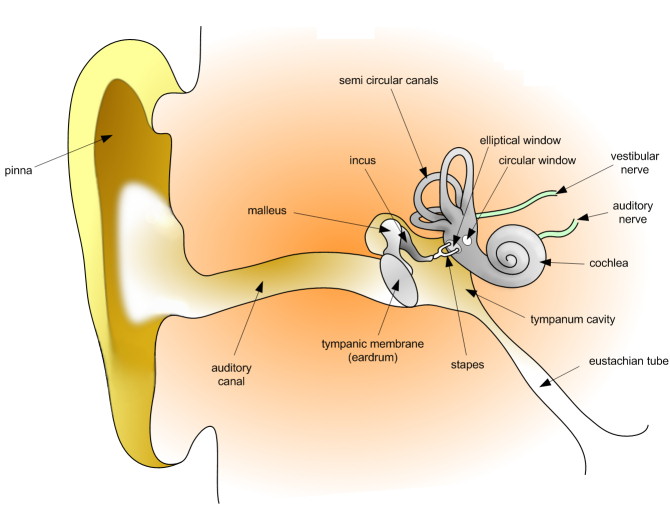
When loud noises enter your ear they are quite violent vibrations entering your ear, which can cause a variety of problems. When entering your eardrum, the violent vibrations of sound can cause your eardrum to shake so violently that it can rip or break, which can be as bad to cause a person to go deaf. If the violent noise makes it to the cochlea, it can cause the hair cells on the inside to shake violently, which can cause the tips to break off, which means they will constantly be emitting electric pulses to your brain confusing it on whether you're supposed to be hearing something or not, making a ringing noise in your ear, which can last from 1 day to the rest of your life. While some loud noises are okay, others will cause damage to your ear that may be permanent and life hindering.

Friday, February 15, 2019

Roller Coaster Project


Summary: In physics there are various parts that allow the universe to function the way it is supposed to. Energy, which is how everything in the universe is powered, allowing for things like movement. There is force, which uses energy to push or pull an object into various different positions. Then there is motion, which is when both energy and force are put together to allow an object to change positions.

Backward-Looking
In or out of school I have never done a kind of work that needs as much knowledge as this one, where the only limitations are the requisites and your budget, and it has to be fully functional .  With little limitations it allows the creativity to run wild, creating something that you can feel attached to unlike most other projects where you just follow the guidelines and your done, with the only drawback being, the crazier the project, the harder the calculations.

Inward-Looking
The thing I like the most about this project is the fact that it is flowing with creativity, showing how my mind works and calculates, and not how it reacts to various tasks. The one thing I dislike about the project is that some of the theme behind our roller coaster is kind of bad, most of our ideas were thought up before we chose our theme, so we built our the around the roller coaster and not the other way around.

Outward-Looking
If I were to give this project a grade I would give it a A-, because there was a lack of thought involved with some parts of the project. Rather than making an interesting roller coaster we decided that we would go with a much, much simpler design than what was necessary . We then came up with various reasons that the organism would evolve to be this way.

Forward-Looking
The one goal I would like to set for next time is:

rather than impeding the final outcome of the project by choosing what a simpler design, then an interesting one. I will look at my capabilities  first, then make decisions based off of that, rather than basic abilities. Allowing me to be more efficient and have a better work ethic to make a better project, and enjoying it along the way.

Sunday, February 10, 2019

Law of the Conservation of Energy


Summary: The law of the conservation of energy states that energy cannot be created or destroyed.. Similar to the law of the conservation of mass, it states that energy can only be transformed. Meaning that when a ball rolls down a hill, the potential energy of the ball isn't destroyed, and then replaced with newly made kinetic energy, but rather the potential energy is transforming into kinetic energy, but some of the energy is transferred to the air, meaning that the ball would not land in a completely proportionate place to how much potential energy it had.

SP2: Developing and using models:
We made small models of roller coasters in class to demonstrate Newton's laws of motion, and other points where parts of physics come into play, such as where on the roller coaster is the kinetic energy the lowest, or where is it the highest. It also allowed us to demonstrate various relationships, like the steepness of a hill to the acceleration, or the friction and the velocity.

XCC: Energy and Matter
The law of the conservation of energy shows how energy cannot be created or destroyed, creating the backbone for a system that doesn't rely of creating or destroying energy, but rather transforming it. Because energy is transformed rather than created or destroyed, it opens up a lot of options on how we can use energy to help us in everyday life. Like turning the mechanical energy of a motor into kinetic energy from the revolutions of a car's wheel.

Sunday, February 3, 2019

Energy


Summary: Energy is how we measure the work that has to be placed on an object to do various things, such as move, or heat something up. There are many different types of energy, one of which is kinetic energy. Kinetic energy is the energy of motion, meaning when something is moving, the type of energy used is kinetic. But before kinetic energy can be put into use, it will be stored as potential energy, which is the energy something could possibly have in its position. Due to the law of the conservation of energy, it cannot be created or destroyed, only transformed.

SP4: Analyzing and interpreting data
This week in class we took a look a various different graphs, of how things like acceleration and energy change over time in specific situations. Like how the kinetic energy of a ball would stay the same until it started to slow down. after we put the data on the graphs, we came to the conclusion that the kinetic energy was being converted into another type of energy. We also saw that at the begging of the situation the potential energy was high, but got lower and lower as the ball moved, it was the exact inverse of the kinetic energy, meaning that it was being transformed into kinetic energy.
 
XCC:Energy and Matter
Due to the law of the conservation of energy, it cannot be created or destroyed, only transformed, meaning that if a ball started on the top of a ramp and rolled down, then the potential energy that the ball had on the top of the ramp was being transformed. Because the rolling the ball would be considered a form of movement, the potential energy of the ball is being turned into kinetic energy. This is true when converting all types of energy into one another.


Friday, January 18, 2019

Forces

Forces 2 carts connected by string By: Guy Vandegrift


Summary: A force is a push or a pull, on an object that makes it move in various different ways. Forces are one of the main parts of Isaac Newton's three laws of motion, which include the law of inertia, F=MA, and for every action there is an equal or opposite reaction. The law of inertia is that if something is in motion, it will want to stay in motion, and if something is at rest it will want to stay at rest. F=MA, is a law that says the more mass something has the larger the force must be. Newton's third law states that if an action occurs there are two reactions, one that is equal, and one is opposite.

SP4: Analyzing and interpreting data
While studying how forces work and interact with each other, we used models on an online service, while we were studying the online service we used the data that we got to make various inferences on how force can effect a single object. We put the data that we gathered into a small graph showing the forces and how far movement was.

XCC Energy and Matter:
When force is applied to a piece of matter, a certain amount of energy must be exerted. The more amount of energy that is put behind a force, there will be a larger amount of newtons in the force. Depending on the mass of the object and the acceleration it is at, the more or less energy a person would have to more or less energy into the force.

Friday, January 11, 2019

Self-Driving Cars, are they the Future?

MWilkinson1004
Mrs. Garcia
Science 8B
01/11/19

Self Driving Cars, are they the Future?

Technology has been advancing rapidly for the past century, with the invention of the first computer to rockets going to the moon, what is next on the agenda for humanity to invent? The next step is self driving cars, a piece of technology that allows transportation without the error of human judgement and various impediments of sight. It allows people to multitask on the road, which could overall improved attitude, and efficiency in the workplace. Self-Driving cars have a lot of benefits to them,  how do all of the features in the cars work, and how are they made?

Human errors are the main cause for car crashes, 1.25 million people die from car crashes every year, with the average driver getting in an accident about every 500,000 miles. Self-driving cars could eliminate human error from the equation, limiting the amount of crashes that happen every year. In the article How Driver less Cars Will Work by Jamie Page Deaton & Kristen Hall-Geisler for How Stuff Works it was said that “Google has had a fleet of driver less cars since 2009, and they've driven over a half a million miles (804,672 kilometers) without a crash.”  Meaning that the cars that google made have driven for a longer distance without getting into a crash, than a human would have. Human Error is usually within the calculations they have to make when driving, because computers are great at  making calculations quickly, it makes them much less likely to get into a car crash than a human would be. Self-driving cars not only make it so that the road is safer for those who can drive, but also for those who cannot.

People who have trouble reacting to different situations and people who never learned how to drive, can use self-driving cars to be able to get to places faster than before, furthermore people who don’t have good eyesight, and various other disabilities can get to the places they need to without having get behind the wheel. When people use self driving cars, they are not looking at the road themselves, that’s the cars job, and the car’s sensors is not impeded by things like a disability or environment condition like when it is night time. In the article PUNY HUMANS STILL SEE THE WORLD BETTER THAN SELF-DRIVING CARS by Aarian Marshall said that “Vehicle-to-vehicle communications could help autonomous vehicles do even better. Technologies like dedicated short-range radio or 5G cellular networks (that one's on the way) could help networks of cars talk about what’s happening on the road.” which means that people who have trouble communicating to others, which is harder on the road, don’t have to do that making the drive safer. Even if it will help people with disabilities, the technology is not perfect, and human eyesight is still better than most driver less cars that are on the road at this point in time.

The technology is used to help driver less cars drive is not perfect in any way shape or form, human eyesight is much more reliable at this point in time for people to drive on the road. While driver less cars are not affected by impairments like the darkness of night, they cannot see various signs and other specific details and react to them, they also have to get the timing perfect when driving so when on a busy crossroads, a person in a self driving car will be waiting for a while. In the article Puny Humans Still See The World Better Than Self-Driving Cars by Aarian Marshall it was said “Indeed, competent drivers are still better than rolling computers in key areas. This is partly because of the limitations of these cars' sensors.” While the technology is not able to keep up with the eyes of competent drivers, they will able able to soon. The technology used to make self-driving cars is still relatively new. Meaning that in the future self-driving cars will be able to keep of with human drivers.

One of the most important things that people will be able to get out of self-driving cars, is that they won’t have to pay attention to the road, meaning they could divert their attention to things like work, or relaxation. In the article Pros and Cons of a Driver less Future by Tony Borroz, the author made a statement: “While being taken from here to there in a driver less car, you can do anything you want. Eat, sleep, work, chat with relatives – commute time is no longer downtime.” When people have more time to relax before work, it allows them to feel more energized, and have better work ethic. Students and younger children that need a lot more sleep can get more, which improves their health. How does the case for self-driving cars stand, even with all of the current opposition to the idea of them ruling the streets instead of humans.

Self-driving cars would be great in the future from now, there are many pros to not having to drive yourself anywhere, while also not having to pay every single time you go to a place. Not only do self driving cars remove the possibility of crashes through human error, they also allow people who have disabilities to get to various places without help from other people. Some people say that human eyes are better than the sensors of the self-driving car, but that is only right now; in the future self-driving cars will have the capability to see better than a well-trained driver. It will also improve the mood of people who drive a lot because they won’t have to be focusing on the road, and on the wheel. Self-driving cars will improve exponentially in the future, just how long will it be before they take the road instead of human drivers?